

Organizational Level
What you need to know
Kiwa Ecobility Experts supports organizations in presenting and reducing their climate footprint transparently. As an accredited service provider, we validate and verify greenhouse gas (GHG) emissions in accordance with ISO 14064-1/-2 and assess carbon neutrality management under ISO 14068-1.
Our independent verification of your Corporate Carbon Footprint (CCF) creates a reliable foundation for strategic decisions and sustainability reporting. By integrating these results into established reporting formats, you ensure transparency for industry partners, policymakers, and the public; a key prerequisite for credible climate action.
The validation/verification of greenhouse gas inventories at the organizational level is based on the GHG Protocol and the ISO 14064 series of standards. ISO 14064-1 provides the basis for calculating and reporting an organization's greenhouse gas emissions. Validation/verification is based on ISO 14064-3.
Benefits of validating your GHG Balance
The validation/verification of your GHG balance by Kiwa-EE offers you the following advantages:
Credibility and transparency
Compliance with legal and voluntary requirements
Improved decision-making basis
Competitive advantage and brand enhancement
Risk minimization
International recognition and comparability
Process
Preparation
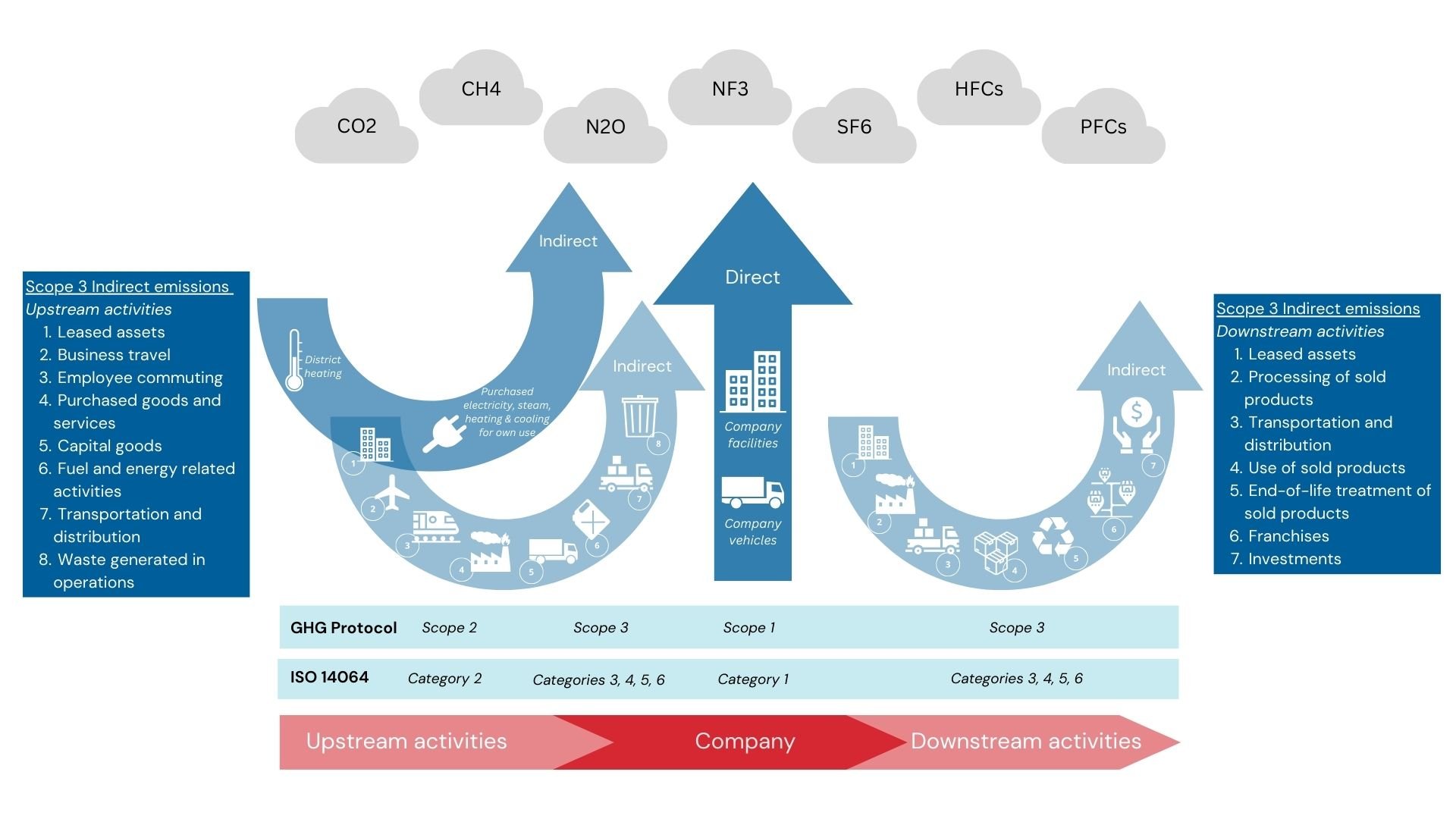 In preparation for third-party verification, it is helpful to understand the various requirements of ISO 14064-1 for calculating a greenhouse gas balance.
The first step is to define the organizational and operational system boundaries. A consolidation approach must be chosen to define the boundaries. For this purpose, the operational control approach is usually chosen. Consequently, all GHG emissions that are under the operational control of the organization are taken into account.
To accurately measure your carbon footprint, it is essential to collect relevant data across direct and indirect emission categories, taking into account the boundaries defined for your organization:
- Scope 1: Direct emissions from stationary or mobile combustion facilities
- Scope 2: Indirect emissions from purchased energy, including electricity, steam, heating, and cooling
- Scope 3: Other indirect emissions within the value chain, such as emissions from suppliers, business travel, product transportation, waste disposal, and purchased goods and services
Quantification
A comprehensive greenhouse gas inventory is compiled by gathering data from internal processes and external partners along the supply chain. Input data from business activities is converted into carbon dioxide equivalent emissions (CO₂e) using industry-standard emission factors to ensure consistency and accuracy in reporting.
Reporting
An effective greenhouse gas emissions report should be comprehensive, transparent, accurate, and aligned with international standards such as the GHG Protocol and ISO 14064-1. This document should primarily include the methodology used for emissions calculations, data sources and assumptions, and a clear breakdown of emissions by Scope 1, 2, and 3. This structured approach ensures that the organization's carbon footprint is accurately represented, which supports the sustainability goals of the organization or company and compliance with legal requirements.
Validation / Verification
Kiwa EE offers accredited and independent third-party validation/verification to validate the accuracy, reliability, and robustness of your greenhouse gas inventory. Validation/verification increases credibility, supports informed decisions, and strengthens stakeholder confidence in your sustainability commitments.
Our process consists of three stages to ensure the integrity of emissions reporting:
Stage 1: Pre-validation/verification
This initial phase assesses whether the organization is ready for full validation/verification. We review data collection processes, evaluate the characteristics of operational processes, and identify potential risks. This step serves as the basis for a customized verification plan for evidence collection in the next stage.
Stage 2: Validation/Verification
This phase is conducted in accordance with ISO 14064-1/-2 and includes a thorough review of data collection, calculation methods, and reporting processes. Our validation/verification team can conduct on-site assessments to ensure compliance with best practices and international standards.
Stage 3: Independent review
An independent review is conducted to provide additional integrity and assurance. This step ensures the consistency of the entire validation/verification process but does not require client involvement.
Our USP's
Accredited validation/verification body
Accredited by the United Kingdom Accreditation Service (UKAS) for ISO 14064-1, -2, PAS 2060 (carbon neutrality), and ISO 14068-1. Additionally accredited by the China National Accreditation Service for Conformity Assessment (CNAS) for verification according to ISO 14064-1.
Global availability and network
Kiwa offers global availability and a network of qualified validators/verifiers with a strong focus on activities in Europe and China.
In-depth expertise
Kiwa has many years of experience in calculating CO2 balances and uses its own calculation software called R<THINK. The software can be purchased for your own calculations and, with an LCA module, also enables the calculation of Environmental Product Declarations (EPDs) and Product Carbon Footprints (PCFs).
Long-term partner
We support you from the basic calculation and setting of climate targets to the realization of savings potential.
Passion and industry knowledge
Our team is committed and has in-depth experience in various industries.
Experience in verification
Kiwa has the expertise and competence to verify your greenhouse gas report and thus offer you real added value.
Interested?
Contact us for services tailored to your company