
Product Level
What do you need to know?
As an established program operator under ISO 14025, Kiwa Ecobility Experts helps you communicate the environmental impact of your products and services. We ensure your data is verifiable and aligned with harmonized European standards.
We handle the external validation and verification required to publish Environmental Product Declarations (EPDs) in recognized databases like ECO PORTAL and ÖKOBAUDAT. This creates a reliable basis for decision making. It enables industry partners, government bodies, and consumers to compare products based on valid environmental facts.
Since independent verification is a mandatory prerequisite for publication, our process ensures your B2B and B2C communication is both credible and legally secure.
The general program instructions form the basis for the operation of the Kiwa-EE program for the creation of environmental information: General program instructions (DE | EN) + Appendix B1 (DE | EN)
Kiwa EE operates the following individual environmental information programs:
Environmental information program in accordance with EN 15804 / ISO 21930
Our program covers the entire spectrum of construction-related products and services. This ranges from raw materials and construction kits (aligned with the Construction Products Regulation) to technical building equipment, such as water and heat supply systems.
As a member of ECO PLATFORM, the umbrella organization for European EPD program operators, Kiwa Ecobility Experts is committed to a harmonized system. We adhere to strict quality standards based on EN 15804 and ISO 21930, ensuring your environmental data is recognized across Europe.
Environmental information program according to EN 50693
The program applies to electrical and electronic products and systems (EEPS), with the exception of technical building equipment products (in the sense of supplying water, heat, etc.).
Environmental Footprint Program (EU 2021/2279)
The program applies to environmental information in accordance with COMMISSION RECOMMENDATION (EU) 2021/2279 of December 15, 2021, on the application of life cycle environmental footprint calculation methods to measure and disclose the environmental performance of products and organizations throughout their life cycle.
Process certification program for environmental information (product level according to ISO 14025)
Environmental information about the program for certifying environmental information process validation/verification serves as an alternative and is used in particular when the products/product groups and thus the specific product category rules are diverse and can only be implemented in standardized validation/verification processes with a very high administrative effort.
This procedure comprises an initial assessment (process monitoring + random sample/product group), followed by regular inspections (process monitoring + random sample testing/product group, in accordance with the requirements of Kiwa-EE). The procedure is evaluated annually by Kiwa-EE.
Product category rules (PCRs/PSRs) and why they are important
Description
Product category rules are specific rules, requirements, or guidelines according to ISO 14025 for creating Type III environmental declarations for one or more product categories. They ensure that the environmental impacts of products in a specific category are recorded and presented according to uniform and comparable criteria.
They are divided into basic product category rules (Core PCR), which are usually sector-specific (EN 15804, 50693, etc.), and supplementary product rules (c-PCRs), which contain product-specific regulations. In principle, c-PCRs must always comply with the corresponding Core PCR.
While Core PCRs are always normative, c-PCRs can be (CEN) standards or created by program operators. Program operators usually create such PCRs when there are no normative c-PCRs.
In addition, there is also the term Product Specific Rules (PSR), which has become established for electrical and electronic products and also specifies calculation instructions and definitions.
The process of creating and maintaining a specific PCR can also be organized and supported by Kiwa-EE. Kiwa EE ensures that product categories are defined in a transparent manner. If products have a similar function and application, they can be assigned to a product category with the same functional unit.
Kiwa EE supports the standardization of product category rules. In this context, cooperation with other program operators exists or is to be sought. Non-normative PCRs/PSRs from third parties undergo a defined recognition procedure at Kiwa-EE.
The Construction Products Regulation (Regulation (EU) 2024/3110) and the associated harmonized European specifications will set uniform product category rules for construction products in the future.
The process of creating and maintaining our own product categories is organized and supported by the Kiwa-EE validation/verification body. It follows the requirements set out in program EE 1201 (General Program Guidelines) and the associated environmental information programs.
When Kiwa-EE develops new product-specific product category rules, it will check whether these requirements are met. LCA expert committees ensure the involvement of interested parties. The aim is transparency, understanding, and acceptance.
Approval is granted by the Kiwa-EE Advisory Board, and the PCRs/PSRs are usually published.
In the field of electronic and electrical equipment, e.g.:
In the field of: Construction sector, e.g.:
Process
Process description
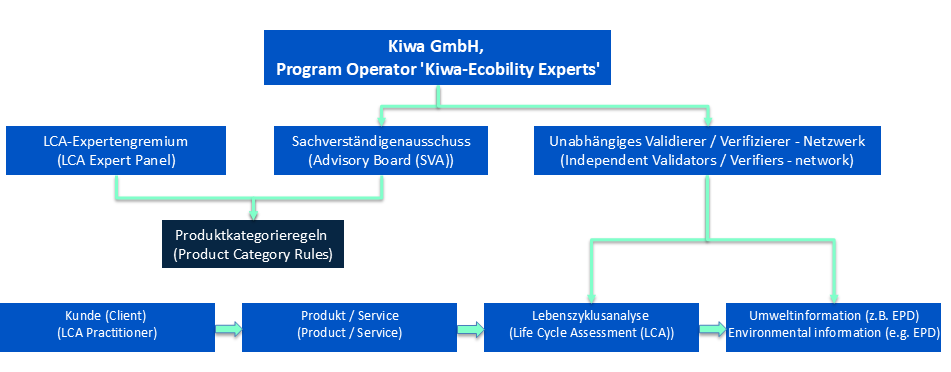
1. Basis of Assessment The foundation of the assessment is the Life Cycle Assessment (LCA). The LCA practitioner shall request the applicable Product Category Rules (PCR) from the Program Operator (Kiwa Ecobility Experts) prior to drafting the environmental information, such as an Environmental Product Declaration (EPD).
2. Commissioning and Independent Review The Client commissions the Program Operator to execute the validation or verification of the environmental information. To fulfill this requirement, the Program Operator engages a network of independent verifiers. These verifiers examine the data and may consult technical experts within the Kiwa Group as required to ensure accuracy. A comprehensive report is generated upon completion of this assessment.
3. Verification Decision Criteria The outcome of the assessment is determined by a formal and content review:
-
Positive Decision: Granted solely when the environmental information satisfies all established requirements.
-
Negative Decision: Issued if the information fails to meet the criteria for validation or verification.
The report documents any nonconformities or deviations and prescribes necessary corrective actions for the Program Operator and the Client.
4. Publication and Delivery Following a positive verification outcome, the Program Operator shall publish the environmental information in recognized databases (such as Kiwa, ECO PLATFORM, or ÖKOBAUDAT) upon request by the Client. The process concludes with the delivery of the final validation or verification report to the Client.
Our USP's
- Kiwa EE is part of the Kiwa Group. The Kiwa Group serves various market segments, from construction and energy supply to drinking water, healthcare, food, feed, agriculture, and consumer goods. With 12,000 employees, Kiwa is a strong international partner in over 55 countries, whose goal is to combine product and system certifications with sustainability aspects for its customers.
- Kiwa-EE is an officially recognized program operator in accordance with ISO 14025 (ECO PLATFORM and ÖKOBAUDAT). Our expertise ensures compliance with international standards and provides credibility and trust in environmental declarations.
- Kiwa-EE has extensive expertise in the field of validation/verification. With over 10 years of experience, Kiwa-EE has successfully carried out more than 700 validations/verifications. Our in-depth industry knowledge and commitment to quality make us a trusted partner in sustainability assessments.
- Kiwa-EE operates a program that does not charge membership or annual fees. This means that you only incur one-time costs for registration, validation/verification, publication, and maintenance, with no further obligations to the organization.
- Kiwa-EE is market-oriented, flexible, and innovative. We have tailored Kiwa-EE to the needs of our customers. Flexible structures and processes enable the organization to adapt quickly to changing market conditions.
Validation report in accordance with the Construction Products Regulation (CPR)
The new Construction Products Regulation (CPR), which came into force on January 7, 2025, regulates the conditions for placing construction products on the EU internal market. It aims to increase product safety, strengthen consumer protection, and facilitate standardization processes. There is a strong focus on environmental and sustainability aspects.
In this context, Kiwa-EE, in cooperation with the notified bodies of the Kiwa Group, offers the following products:
Platforms for publication
After validation/verification, the environmental information (e.g., EPD) is published.
The environmental information (e.g., EPD) can be published on the Kiwa website: EPD database of Kiwa Ecobility Experts.
In addition, the environmental information (construction products) will be uploaded to the following databases, upon request and subject to the respective requirements being met:
We are happy to assist you in publishing your environmental information on these databases.
Environmental Product Declarations (EPD) – The Kiwa Ecobility Experts database
Frequently Asked Questions
What is a Program Operation?
A program operator is an entity that operates Type III environmental information programs in accordance with ISO 14025. All tasks of the program operator are defined in ISO 14025. Specifically, the program operator's responsibilities include the management of the following tasks:
• Provision and publication of general program guidelines,
• Establishment of program procedures and adaptation of program procedures to current developments in the areas of standardization, life cycle assessment methodology, etc.,
• Ensuring that the requirements for Type III environmental claims are met,
• Establishment and involvement of interested parties (LCA expert panel),
• Providing and maintaining a process that ensures data consistency
within the program,
• Organizing the Expert Committee (SVA),
• Monitoring the competence and independence of the
pool of validation/verification staff,
• Organization of a transparent procedure for the creation of specific product category rules,
• Development of procedures to prevent the
misuse of Type III environmental declarations,
• Publication of environmental declarations in relevant databases,
• Tracking of changes after the issuance of environmental declarations, adjustments if necessary,
• Collaborating with the notified bodies of the Kiwa Group to prepare validation reports on environmental sustainability in accordance with the Construction Products Regulation,
• Collaborating with the Technical Assessment Body of the Kiwa Group in implementing environmental sustainability in the EADs in accordance with the Construction Products Regulation.
What are the general program instructions?
The general program guidelines form the basis for the operation of the Kiwa-EE program and regulate the administrative and operational processes for the creation and publication of Type III environmental information (e.g., EPDs) in accordance with ISO 14025.
The general program guidelines are updated every three years to continuously adapt the Kiwa-EE program operation to current developments in the field of standardization, life cycle assessment methodology, etc.
What is an Independent Advisory Board / Sachverständigenausschuss (SVA)?
The SVA is responsible for monitoring impartiality and neutrality in the implementation of program operation tasks.
The following tasks are performed by the SVA of Kiwa-EE:
• General advice on program operation
• Review and approval of the respective program principles and conformity assessments as well as the associated rules
• Technical monitoring of the use of environmental information programs for Type III environmental declarations in accordance with ISO 14025,
• Review and approval of the development and review procedures for the methodological and editorial product category rules applied by Kiwa-EE,
• Reviewing the quality of environmental information and related documents,
• Annual review of validation/verification personnel based on competence monitoring,
• Exchanging information with Kiwa EE on the latest findings, research, and activities in the field of sustainability to ensure that the programs are always up to date,
• Decisions and dispute resolution regarding non-compliance with program rules,
• Handling of appeals in the event of complaints.
The SVA operates independently and defines its tasks, organization, and working methods in its rules of procedure.
What is the process for publishing environmental information (e.g., EPDs)?
Once the data has been collected, data validation takes place. In the next step, life cycle assessment modeling is carried out based on the data. A draft project report and environmental information (EPD) are prepared in accordance with applicable standards and product category rules (PCR). The documents are checked by a validator/verifier commissioned by Kiwa-EE for completeness, consistency, and plausibility, as well as for compliance with the applicable specifications. After a positive validation/verification decision, the environmental declaration and, if applicable, the project report (environmental information) are published.
What does Validation / Verification mean?
Validation/verification is an independent and critical review that ensures the quality and consistency of environmental information, such as an environmental product declaration (EPD). Successful completion of validation/verification is usually required for publication.
The validation/verification body organizes the entire process and issues a corresponding validation/verification statement based on all necessary objective evidence. An LCA or environmental information tool (software) can also be used for this purpose, which will also be used to generate environmental information in the future.
The results or partial results of specific life cycle assessments (LCA) in accordance with ISO 14040/ISO 14044 and the program- and product category-specific calculation rules serve as the basis. These analyses are carried out by third parties; such as product manufacturers or external LCA experts; and are considered third-party information in accordance with ISO/IEC 17029.
The process stipulates that the data must always be checked by Kiwa-EE, especially if it originates from external parties. Depending on the reference scenario of the data, a distinction is made between a validation and a verification approach. In accordance with Kiwa EE's general program guidelines, data originating from a mixture of hypothetical, extrapolated, and/or historical information may also be used (see ISO/IEC 17029).
Validation:
Process for assessing the appropriateness of the assumptions, limitations, and procedures underlying an environmental claim about the outcome of future activities.
Verification:
Process for assessing an environmental claim against historical data and information to determine whether the claim is substantially accurate and meets the criteria.
Validation must include, in particular, an assessment of the assumptions, limitations, and procedures that lead to the determination of hypothetical or projected data and information (estimates).
What is the Shadowing Training Program?
LCA and environmental declaration experts who would like to gain practical experience in validation and verification as part of training courses together with an accredited validator/verifier can apply for this program. Participation can be an important prerequisite for subsequent recognition as a validator/verifier in the Kiwa Group network.
What are the Validation/Verification procedures at Kiwa-EE?
Standard:
This applies to all environmental information that is not covered by a customized software-based tool. It includes a detailed review of the data, system boundaries, LCA parameters, and compliance with relevant standards. An iterative validation/verification process ensures consistency, and the output presentation of the environmental information (declaration) is checked for comparability.
LCA tool:
LCA tools require approval by Kiwa-EE and have fixed, non-editable calculation methods. The tool generates predefined environmental indicators, with validation/verification focusing on the input data and the plausibility of the results. After initial approval, subsequent declarations undergo simplified validation/verification, and reapproval is required every five years or after significant tool changes.
Environmental information tool – Variant 1:
Similar to LCA tools, this method automates environmental information based on predefined rules. Users enter product-specific data, and the tool generates validated/verified output documents. Changes to the tool require reapproval every five years, and further validation/verification focuses only on variable input data and the plausibility of the results.
Environmental information tool – Variant 2:
As an extended version of Variant 1, this approach includes the validation/verification of administrative processes, data integrity, and logging. Instead of checking each piece of information individually, conformity is ensured by an annual random check of at least three pieces of information (e.g., EPDs). In addition, updates are tracked during the creation of environmental data and quality assurance processes.
What costs should be expected for the validation/verification and publication of environmental information (e.g., EPD) via Kiwa-EE?
The costs for validation/verification and subsequent publication of environmental information (e.g., an EPD) depend on various parameters. Relevant parameters for determining the costs are the complexity of the product, the product group, and the number of individual pieces of environmental information to be verified.
Interested?
Contact us for services tailored to your company