

Product Category Rules (PCR) for Environmental Product Declarations
Receive a quote tailored to your needs
What are Product Category Rules (PCR)?
PCRs are specific rules and guidelines for creating EPDs for a product category in accordance with ISO 14025. They ensure that EPDs within a category are created using comparable methods.
A PCR contains:
- Product category: Definition and delimitation
- Functional unit: Reference value for comparisons
- System boundaries: Which life cycle phases are considered?
- Data quality: Requirements for primary and secondary data
- Allocation rules: Allocation for co-products
- Environmental impacts: Categories to be declared
The hierarchy of PCRs
PCRs are structured hierarchically. Each level complements the one above it.
Important: Supplementary rules must always be consistent with the core PCR.
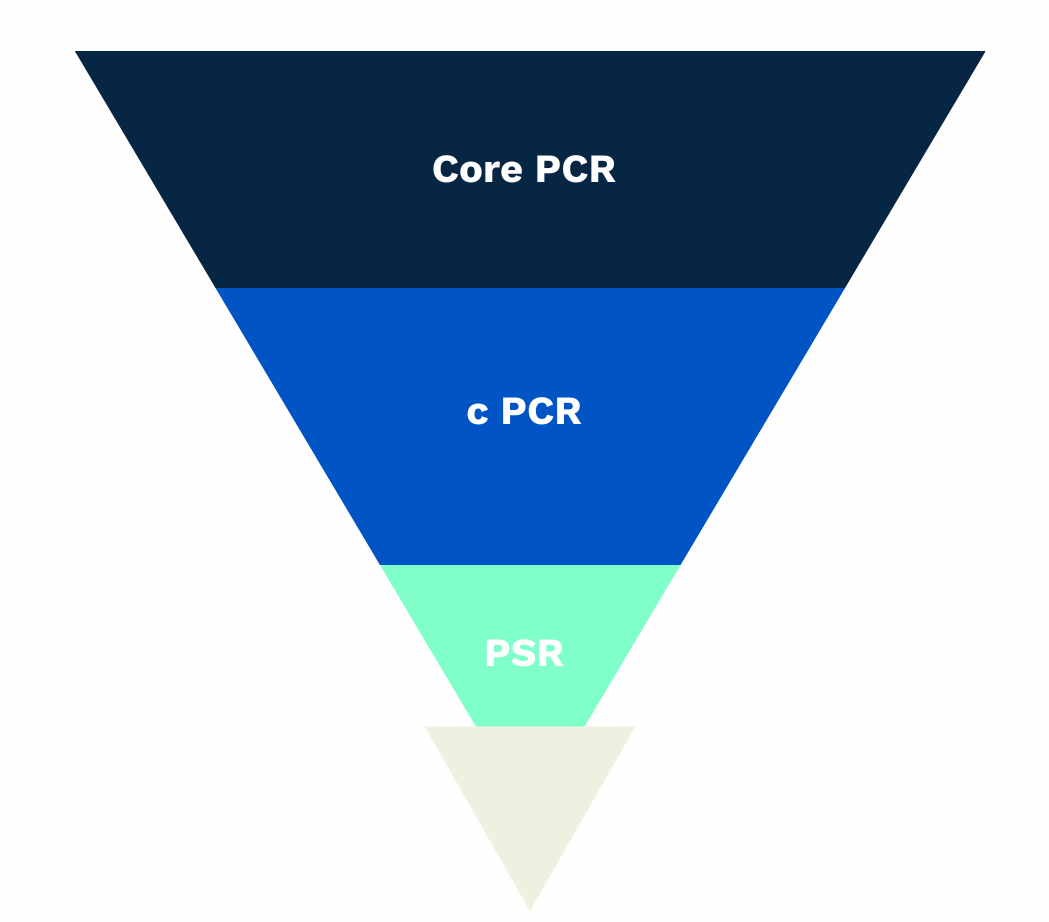
Core PCR (basic) Sector-specific basic rules, e.g.
- Construction products: EN 15804
- Electronics: EN 50693
c PCR (supplementary) Product-specific additions to the Core PCR
- Harmonized European standards (hENs, EADs)
- Or developed by program operators
v(product-specific) Detailed calculation instructions for specific product groups
- Cements, thermal insulation materials, windows, and doors
How do PCR and EPD differ?
| Aspect | PCR | EPD |
| What is it? | Regulations/ Methodology | Product documentation/ Declaration |
| Scope | Entire product category | Individual product |
| Creator | Program operator, Standardization committee | Manufacturers with LCA expertise |
| Content | Calculation rules, System boundaries | Specific values for the respective environmental indicators |
| Verification | Stakeholder process | Independent verifier |
In short: PCR defines the rules of the game. EPD is the result of applying these rules to a specific product.
Why are PCRs important?
- Comparability Without uniform PCRs, EPDs for similar products could be based on completely different assumptions. An EPD for window A would not be comparable with window B.
- Credibility PCRs are developed in open processes involving industry, science, and environmental organizations.
- Market acceptance Only EPDs based on recognized PCRs are accepted by databases such as ÖKOBAUDAT and can be used for DGNB or LEED.
- Regulation The new EU Construction Products Regulation (2024/3110) will specify uniform PCRs via harmonized European specifications.
Why Kiwa Ecobility Experts?
Kiwa Ecobility Experts is recognized as a program operator for environmental product declarations in accordance with ISO 14025.
What we do:
- PCR development: New rules for product categories without existing PCRs
- PCR maintenance: Updating existing documents
- PCR recognition: Validation of PCRs from other program operators
Our development process:
Definition
Expert panel
Involvement
Approval
Publication
Available PCRs from Kiwa
In the past, we have developed a number of new PCRs/PSRs for different product categories. The following current PCRs/PSRs can be named:
Construction sector:
- Fire Hose Reel with semi-rigid hose
- Geosynthetic Products
Electronics:
- Commercial Coffee Machines
Download the available PCRs:
When do you need a new PCR?
A new PCR is required if:
- No suitable PCR exists
Solution: Develop a new PCR with Kiwa
- Existing PCR is not suitable
Solution: Supplementary rules or new PCR
- Lack of comparability within the industry
Solution: Industry-wide PCR development
Recognition of PCRs from other program operators
PCRs from other program operators can undergo a recognition process at Kiwa.
This enables:
- Use of international PCRs for EPDs at Kiwa
- Recognition of industry-specific rules
- Synergies between program operators
Validity and updating
Validity period: Generally 5 years with mandatory review
Reasons for updating:
- Changes in standards (e.g., EN 15804)
- New scientific findings
- Technological developments
- Feedback from practical experience
Transition periods: In the case of updates, old and new versions may apply in parallel.
Frequently Asked Questions
What are Product Category Rules?
A set of rules that defines the criteria according to which EPDs are created for a product group; including system boundaries, calculation methods, and data quality.
What is the difference between PCR and EPD?
The PCR is the set of rules. The EPD is the result, the specific environmental declaration of a product according to the PCR specifications.
What is the difference between EPD and PCF?
An EPD contains comprehensive environmental impact data. The PCF only records greenhouse gas emissions.
How much does an EPD cost?
Depending on product complexity and data availability.
Is an EPD mandatory?
Basically voluntary. De facto required for DGNB, public tenders, and supply chain requirements.
Contact Us
We create your PCR according to EU methodology.
Our services:
- PCR development for new product categories
- EPD creation based on existing PCRs
- Independent EPD verification


