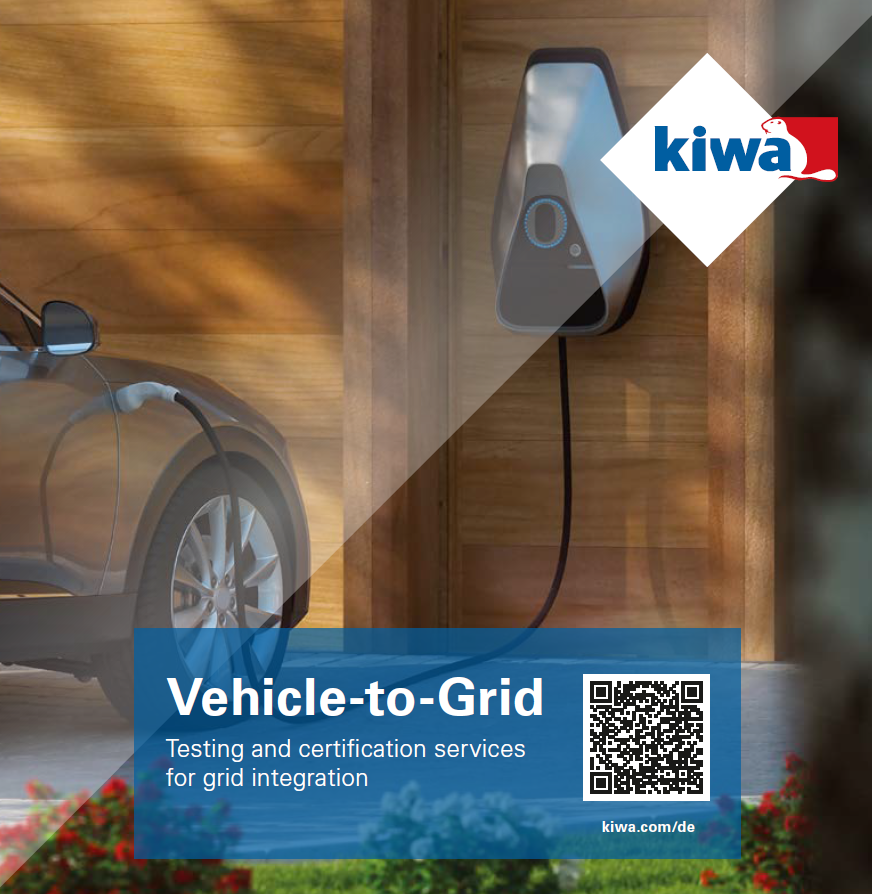

Vehicle-to-Grid (V2G) certification for grid integration
Receive a quote tailored to your needs
What is vehicle-to-grid?
V2G (Vehicle-to-Grid) refers to the bidirectional charging of electric vehicles. In this process, the vehicle is not only charged, but also used as a temporary battery storage device to feed the stored energy into the power grid or the energy system of the home. V2G is the next logical step following smart charging (Grid-to-Vehicle) and enables grid-friendly charging of electric vehicles.
What other areas of application are there?
V2X (vehicle-to-everything) is a collective term for various sub-forms of feeding electricity back from vehicles and includes, among other things:
V2B (vehicle-to-building): Avoiding peak power consumption for companies with their own electric vehicle fleet.
V2H (Vehicle-to-Home) - temporary storage of electricity from a PV system for single-family home owners,
V2V (Vehicle-to-Vehicle) - energy exchange between two or more electric vehicles,
V2L (Vehicle-to-Load) - operation of electrical appliances with power supplied directly from the vehicle.
How does vehicle-to-grid work?
Electric vehicles are connected to the public power grid via a bidirectional charger. This V2G charger allows electricity to flow in both directions, enabling the electric vehicle to temporarily store excess electricity from the grid when needed, but also to feed it back into the grid later.
Vehicle-to-grid technology thus serves as load management for the public power grid, helping to balance the grid and prevent power outages or other disruptions. Electric vehicles become an active part of the power grid and must comply with future grid code standards.
What are the advantages of vehicle-to-grid?
- Controlled charging cycles at times when prices are lower
- Electricity storage for times when there is no solar or wind energy generation
- Reduction in overall costs for fleet solutions
- Supply of electricity to public charging stations
- Grid operators can optimize investments and stabilize the grid
- Energy market players can better optimize the balance in the grid
How do you benefit from working with Kiwa?
- DAkkS/ilac accredited testing laboratory
- Certificates of conformity according to national and international standards
- Many years of experience with grid-connected self-generation plants
and global market access" - Bi-directional DC power supply up to 1500 V and 150 kW
- Bi-directional AC power supply up to 630 Vac and 135 kW
- Provision of cooling fluid between -40 °C and +60 °C
- Fully variable CAN bus system with up to 4 channels
- Environmental simulation tests
- Large international network with many other testing options
Vehicle-to-grid certifications:
We test and certify according to international standards!
Europe
- EN50549-10
Denmark
- Technical Regulation 3.3.1 & 3.3.2
Poland
- General Application Requirements
Here you can find the Kiwa Primara certification programs in the field of grid integration.
Accreditation
Thanks to our numerous national and international accreditations and certifications, you can be sure that our work meets high quality standards, certificates, and attestations enjoy excellent worldwide acceptance. Kiwa Primara has been accredited by the German Accreditation Body (DAkkS) since 2011 in accordance with DIN EN 17025 and DIN EN 17065 to test and certify electrical equipment. In addition, we offer testing and certification in accordance with the IECEE CB Scheme procedure and are a recognized GS certification body.
Download