
How Deep Does GPR Go?
When asked, “How deep does GPR go?” people often expect a straightforward answer without considering the site’s specific conditions. GPR signal depth, also known as depth penetration or maximum depth, refers to the maximum depth from the surface where a reflection from a target can still be distinguished from noise in the registered signal.
Main Factors Affecting GPR Penetration Depth
A common misconception is that GPR penetration depth depends solely on the equipment used. While the instrument parameters do play a role, the fundamental laws of physics governing GPR signal propagation and attenuation cannot be altered.
Material Conductivity
Water Content
Antenna Frequency and Power
Estimating GPR Depth
Without collecting and analyzing data from a specific site, we can’t definitively answer how deep GPR can go. However, we can estimate it based on relevant factors like soil material, concrete mix, and used aggregate.
In certain soil types, signal penetration may be limited to less than a meter, while in others, it could reach several tens of meters. GPR is particularly effective for surveying glaciers, where it can map out the bottom of the ice.
For common applications like utility locating and shallow subsurface surveys, mid-frequency GPR provides sufficient depth penetration and resolution for detecting utilities, oil tanks, shallow voids, and buried structures. Despite its constraints, GPR is a valuable tool for quickly surveying subsurface conditions.
So, how deep does GPR actually go? It varies based on the site’s specific conditions. However, with the right equipment and understanding of the influencing factors, GPR can provide valuable insights into the subsurface, revealing hidden structures and materials.
The chart below shows a good estimation of how deep a low frequency GPR could “see”. Low frequency is typically regarded as below 100MHz.
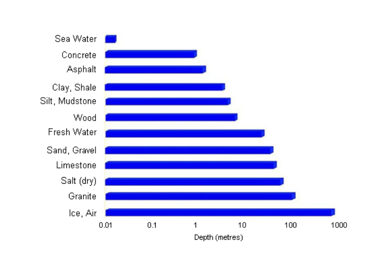
Chart of exploration depths in common materials. These data are based on “best case” observations.
(Source: sensoft.ca)
During a typical GPR application, such as utility locating and similar shallow subsurface surveys, we tend to use a mid frequency range GPR that provides sufficient depth penetration and resolution for the most common types of targets. This includes utilities, oil tanks and similar USTs, shallow subsurface voids and various buried structures. Although there are constraints when using GPR, it is always a good option to deploy a quick GPR survey and see, whatever is lurking below may be just above the maximum signal penetration depth.