
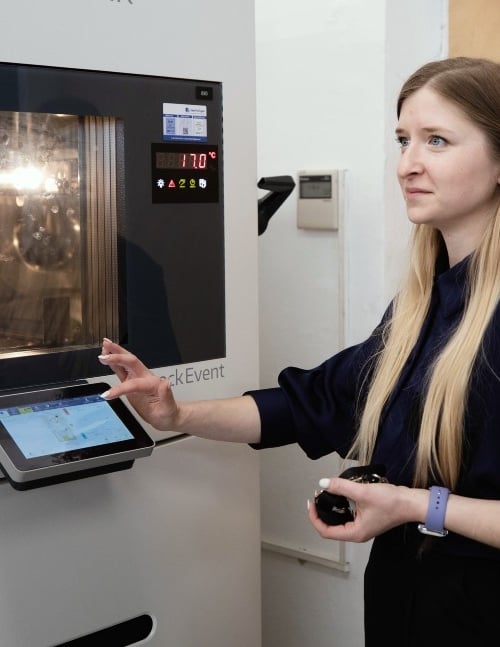
Reliable Battery Testing According to Global Standards
Receive a quote tailored to your needs
Kiwa: Your Partner for Certified Batteries
Your professional partner for battery testing according to IEC, EN, ISO, UN, UL, and MIL/RTCA standards. We are experts in testing various battery types, including primary and secondary lithium-ion batteries as well as other technologies.
Our services include electrical and mechanical tests, environmental testing, abuse testing, and safety testing. We apply state-of-the-art methods and use highly advanced equipment.
Tailored Testing Services According to Your Requirements
At Kiwa Primara, we understand that your requirements can be individual. That is why we offer customized testing precisely tailored to your specific needs and demands. Our modern facilities and equipment enable a wide range of tests, such as short-circuit, overcharge, temperature (shock) testing, vibration and shock testing, propagation testing, nail penetration, cell cycling, and more.
Safety Testing
Safety tests are essential for use in electric vehicles, consumer electronics, medical devices, and other applications. Certified batteries provide safety and reliability for both end-users and regulatory authorities. Compliance with international standards ensures that batteries are safe.
Mechanical Tests: Batteries are crushed, penetrated, exposed to impacts, and tested for resistance against mechanical stress.
Electrical Tests: Overload, short-circuit, and other electrical abuse tests simulate extreme conditions.
Thermal Tests: Examination of thermal stability, fire behavior, and overtemperature.
We test and certify according to international standards!
UN38.3, IEC 62281, IEC 62133, IEC 62619, IEC 62620, IEC 62660, IEC 60086, IEC 61427, IEC 61960-3, IEC 62984, IEC 63056, IEC 63057, RTCA DO-311, UL2271, UL1642, UL2054, UL9540, UL1973, etc.
Environmental Requirements
Different product characteristics, such as functionality or service life, significantly depend on environmental conditions. This includes not only the environmental conditions at the place of operation but also those during transport or storage. We are also accredited for the military and aerospace sectors.
We test and certify according to international standards!
IEC 60068-2-xx, IEC 60529, EN 60695-2-11/-12/-13, EN 60255-x, EN 61373, ISO 6270, ISO 9227, ISO 16750-1, ISO 20563, MIL 810, MIL 883, RTCA DO-160, RTCA DO-311, etc.
Functional Safety of Battery Management Systems (BMS)
A Battery Management System (BMS) is essential for the functional safety of a battery, particularly for lithium-ion batteries. It monitors and controls various battery parameters such as voltage, current, and temperature to ensure the battery operates within safe limits and is protected against overcharge, deep discharge, overheating, and other hazardous conditions. Functional safety in the BMS is crucial to minimize risks and increase the reliability and lifespan of the battery.
We test and certify according to international standards!
IEC 60730-1, IEC 61580, ISO 13849-1
Accreditation
Thanks to our numerous national and international accreditations and certifications, you can be sure that our work meets high quality standards, certificates, and attestations enjoy excellent worldwide acceptance. Kiwa Primara has been accredited by the German Accreditation Body (DAkkS) since 2011 in accordance with DIN EN 17025 and DIN EN 17065 to test and certify electrical equipment. In addition, we offer testing and certification in accordance with the IECEE CB Scheme procedure and are a recognized GS certification body.
Our Accreditations and Services: DAkkS accredited:
DAkkS accredited testing
The DAkkS accredited testing can be conducted for the following standards:
- IEC 62133-1 and IEC 62133-2 testing for Nickel and Lithium batteries and their cells used in portable end-products
- IEC 62619 testing for Lithium batteries and their cells for industrial applications
- IEC 63056 testing for secondary lithium cells and batteries for use in electrical energy storage systems
- IEC 63057 testing for Secondary lithium batteries for use in road vehicles not for propulsion
- UN38.3/IEC 62281 testing for transportation testing of Lithium Batteries
- IEC 61960-3 testing for performance testing of secondary cells and batteries
- IEC 62660-1/2/3 testing for Secondary lithium-ion cells for the propulsion of electric road vehicles
- IEC 61427 testing for the performance of secondary cells and Batteries for renewable energy storage
- RTCA DO 311A testing for minimum Performance Standards for Rechargeable Lithium Batteries and Battery Systems
Testing according to the UL standards
Via cooperation with a partner laboratory, Kiwa can offer you following UL standards:
- UL2271 for LEV application batteries
- UL1642 and UL2054 for primary and secondary lithium cells and batteries
- UL1973 for Stationary and Motive Auxiliary Power Applications batteries
IECEE CB accredited testing and certification
- IEC 62133-2 - Secondary cells and batteries containing alkaline or other non-acid electrolytes - Safety requirements for portable sealed secondary lithium cells, and for batteries made from them, for use in portable applications - Part 2: Lithium systems
- IEC 62619 - Secondary cells and batteries containing alkaline or other non-acid electrolytes - Transport of lithium-ion cells and batteries
- IEC 60086-1 - Primary batteries - Part 1: General
- IEC 60086-2 - Primary batteries - Part 2: Physical and electrical specifications
- IEC 60086-3 - Primary batteries - Part 3: Watch batteries
- IEC 60086-4 - Primary batteries - Part 4: Safety of lithium batteries
- IEC 60086-5 - Primary batteries - Part 5: Safety of batteries with aqueous electrolyte
- IEC 61960-3 - Secondary lithium-ion cells for use in industrial applications - Part 3: Safety requirements
- IEC 62281 - Safety of primary and secondary lithium cells and batteries during transport.
Cell Performance (ageing) testing
Battery cell aging is necessary to determine the lifespan and performance of the battery. This process involves exposing the battery to different environmental and other factors, like temperature and cycling. This simulates the effects of long-term use.
We can identify potential safety hazards by subjecting battery cells to certain conditions. Additionally, we can evaluate the impact of aging on battery capacity, internal resistance, and other critical parameters.
Our laboratory can provide numerous channels with up to 5 V. Each channel has a maximum current of 50 A. We can also apply 1000 A in parallel. Furthermore, we can apply different temperature profiles for ambient conditions.
We record and measure data on capacity and internal resistance. This provides a comprehensive evaluation of the battery's performance and aging characteristics.
The data collected from this process is then used to develop detailed models of the battery’s performance and aging characteristics. This information is used for multiple purposes. It helps inform future design decisions, optimize battery performance, and guarantee safety and reliability for the intended application.
Our laboratory is equipped with advanced testing capabilities. We can simulate various real-world scenarios, such as high temperature and repeated discharging and recharging. We can also simulate extreme conditions. This allows us to evaluate the battery’s performance under a wide range of environmental and other conditions.
UN38.3 Transportation testing
At Kiwa Primara, we understand that ensuring the safety and reliability of lithium batteries during transportation is essential. That's why we offer UN 38.3 Transport Test services to ensure that your batteries meet the required safety criteria. This test includes a total of eight individual tests that are dependent on the type of lithium battery or cell.
Individual tests according to UN38.3:
T1: Height Simulation / Altitude
T2: Thermal test
T3: Vibration
T4: Shock
T5: External short circuit
T6: Impact (cell)
T7: Overload test / Overcharge
T8: Forced discharge (cell)
We carry out tests to make sure your lithium batteries are safe to transport. This reduces the risk of accidents and ensures they comply with regulatory requirements.