Yara’s chimney inspected safely without scaffolding – 3D model provided a detailed overview of its condition

Yara Suomi, a supplier of fertilizers and environmental solutions, wanted to assess the condition of a concrete chimney at its sulfuric acid plant in Siilinjärvi. Using traditional methods, the inspection would have been a demanding task, requiring extensive scaffolding to be erected around the tall chimney. However, there was also an alternative: a new inspection method that would eliminate the need to work at height altogether.
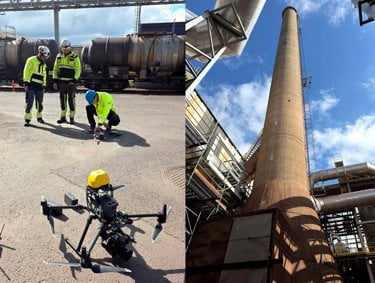
An intelligent inspection was chosen as the solution. The chimney was photographed using drones, and the image data was analyzed with AI-powered software. The inspection results were compiled into a detailed 3D model, in which damage and other findings identified in the chimney structure were marked with their precise locations.
SkyeBase was responsible for preparing and carrying out the drone operation for the project, including flight planning, the necessary flight permits, equipment, and the collection of high-resolution image data together with Kiwa’s experts.
Reference project sparked interest in the new method
Marko Puhtila, Inspection and Reliability Manager at Yara, had first heard about Kiwa’s method a few years earlier. In a reference project presented by Kiwa, the condition of a grain silo was assessed using both a traditional visual inspection and AI-based drone imaging. The drone-based inspection identified the same damage as the traditional inspection and also revealed additional findings.
When the time came to inspect the chimney at the sulfuric acid plant, Puhtila saw it as a good opportunity to try the method in practice. According to Puhtila, the inspection proceeded as planned and without difficulty.
The inspection was completed quickly. Cooperation with Kiwa is smooth and professional. Kiwa also maintains a high level of safety.
3D model made it easier to locate damage
According to Puhtila, drone-based inspection offers several advantages over traditional inspection methods, but one stands out above the rest: the 3D model.
Spotscale processed the image data collected by the drones into a photogrammetric 3D model and used its inspection software to identify and highlight concrete damage, such as cracks, spalling and visible corroded reinforcement, in the model.
The 3D model made it possible to view the chimney on a computer from different angles and easily examine areas of potential damage. According to Puhtila, areas requiring repair were easier to identify than in a traditional inspection report.
“The 3D model was very clear and made it easy to visually pinpoint exactly where the damage was located in the chimney structure,” Puhtila says.
For Yara, the visual overview was not merely the end result of the inspection, but an important tool for maintenance planning. Once a reliable and accurate overall picture of the structure’s condition had been obtained, it was possible to assess whether the identified issues required immediate action or whether maintenance measures could be planned for a later date.
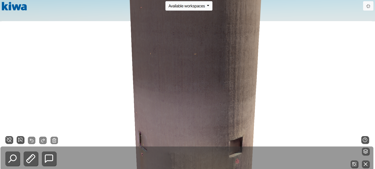
In the photogrammetric 3D model, the damage is highlighted in different colours, making it easy to locate at a glance.
Extensive scaffolding was avoided entirely
In addition to providing a better overview of the chimney’s condition, the drone-assisted inspection brought Yara significant benefits in terms of costs, safety and practical implementation.
Inspecting a difficult-to-access structure such as a tall chimney using traditional methods would have required extensive scaffolding. By using a drone, scaffolding was avoided entirely, reducing costs and occupational safety risks.
The drone also made it possible to carry out the inspection safely while the plant remained operational. This meant that no separate production shutdown was required for the inspection.
The inspection of the tall chimney would have required extensive scaffolding, which is very expensive. By avoiding the need for scaffolding, the safety risks were also reduced, as there was no need to work at height.
Open cooperation enables new methods to be tested
For Yara, the inspection was not just a one-off trial, but part of a long-term and open collaboration with Kiwa. According to Puhtila, one of Kiwa’s particular strengths is developing new inspection methods and making them available to customers.
“Kiwa does not rely solely on traditional inspection methods, but continuously develops its operations and introduces new innovative methods that we can test together,” Puhtila says.
The inspection also revealed a positive surprise: the chimney was in better condition than had been estimated beforehand.
“There is no need to take any immediate action. Instead, we can start planning future repairs as intended,” Puhtila says.
Yara Suomi Oy
Yara is a global producer of fertilizers, environmental protection products, and industrial chemicals. In Finland, Yara has production facilities in Siilinjärvi, Uusikaupunki, and Kokkola, as well as a plant in Nokia that manufactures recycled fertilizers.
Yara’s low-carbon-footprint fertilizers and farming solutions play an important role in the development of sustainable agriculture. Yara Siilinjärvi’s main products are fertilizers, apatite, and phosphoric acid. In addition to the chemical plants, Siilinjärvi is home to the EU’s only phosphate mine, which produces the world’s purest phosphorus as a raw material for fertilizers and feed phosphates.
The products manufactured at the site are primarily used in domestic crop farming and forest fertilization, as well as in the production of animal feed. Yara is a major employer in the Kuopio region and the largest industrial employer in Siilinjärvi. Including partners, approximately 700 people work at the site.
Contact us
Would you like to know more about Kiwa Intelligent Inspection services? Fill out the form and contact our experts.
Read more
Why does ISO 27001 matter for supply chain security?
Cyberattacks rarely impact a single company. Instead, the shockwaves are felt through the chain, impacting suppliers, technology providers, and other third parties. Recent high-profile information security incidents have highlighted this, with several affecting everything from online orders to the availability of products in stores. For Linda Porter, Principal Assessor, Information Security Management Systems at NQA, a Kiwa company, these incidents demonstrate why organizations are paying closer attention to how they manage their suppliers, and how ISO/IEC 27001:2022 for information security can help.

What do you need to adopt ISO 27001? The clauses and controls explained
If your company decides to adopt the information security standard ISO/IEC 27001:2022, you are faced with ten clauses and 93 Annex A controls. At first, these can seem overwhelming. However, once you understand how all those elements work together, the process becomes simpler. In this article, Linda Porter, Principal Assessor, Information Security Management Systems at NQA, a Kiwa company, explains what you need to adopt ISO 27001 in your company.

Read our step-by-step guide on how to get ISO 27001 certified
In a world where big data, online connectivity, and AI integration are at the core of business infrastructure, ensuring safety and security is indispensable. That's why companies turn to ISO/IEC 27001, the international standard for information security. We asked Linda Porter, Principal Assessor, Information Security Management Systems at NQA, a Kiwa company, to tell us more about ISO/IEC 27001:2022 and the process of getting certified.

Yara’s chimney inspected safely without scaffolding – 3D model provided a detailed overview of its condition
Yara Suomi, a supplier of fertilizers and environmental solutions, wanted to assess the condition of a concrete chimney at its sulfuric acid plant in Siilinjärvi. Using traditional methods, the inspection would have been a demanding task, requiring extensive scaffolding to be erected around the tall chimney. However, there was also an alternative: a new inspection method that would eliminate the need to work at height altogether.
