

Certification
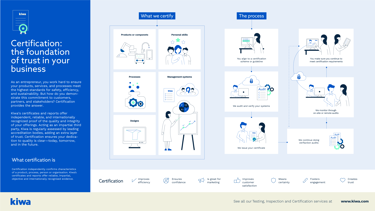
Certification is a powerful tool for demonstrating compliance, credibility, and performance. It provides independent, third-party assurance that products, systems, and processes meet recognized standards and expectations.
Kiwa supports organizations with accredited certification services that are trusted worldwide—helping clients strengthen their position, access new markets, and build lasting confidence among stakeholders.


What We Do
Kiwa certifies a wide range of systems, products, and supply chain processes across industries. Our work is based on rigorous, independent evaluation—ensuring that requirements are not only defined, but consistently met in practice.
From management systems to product compliance, from food safety to cybersecurity, our certification services reflect the diversity and complexity of modern business environments.
Why Certification Matters
In today’s global marketplace, certification is often a prerequisite for doing business. It enables organizations to meet regulatory requirements, satisfy customer expectations, and differentiate themselves in competitive markets.
More importantly, certification provides evidence. It transforms internal processes and commitments into externally validated proof—strengthening trust with customers, partners, regulators, and investors.
How Kiwa Delivers Value
Kiwa goes beyond issuing certificates. We help organizations improve performance, strengthen governance, and embed best practices into daily operations.
Our auditors combine technical competence with industry insight, ensuring that every certification delivers real value. With global recognition and local expertise, Kiwa helps clients move forward with confidence.
Frequently asked questions about Certification
What is certification?
Certification refers to the confirmation of certain characteristics of an object (a product), process, person or organisation. In most cases, this confirmation is provided by some form of external review, assessment, or audit. So, an accredited or authorised person or agency assesses and verifies (and attests in writing by issuing a certificate) the attributes, characteristics, quality, qualification, or status of something or someone. The assessment and verification are in accordance with established requirements or standards.
Why should I certify?
A certificate creates trust. Trust in your products, services, (management) processes and employees. Your certificate enables you to demonstrate that your organisation works efficiently and safely, that you manage the work and work processes and that you strive to be sustainable. It allows you to reduce risks, improve the quality of your organisation and have more satisfied clients. An independent third party like Kiwa ensures it stays that way.
Apart from creating trust, here are additional reasons for certification.
Certification means certainty
A certificate means certainty for clients on a global scale as they can be sure that your management system, process or product meets widely supported (international) objective requirements and the conditions they impose. When it comes to certification of persons and personal skills, a certificate offers certainty about the knowledge, competence and skills that someone needs to perform certain activities. The requirements attached to the certificate have been assessed by an independent third party like Kiwa.
Certification improves efficiency
Certification can improve efficiency: your operations are more comprehensive, efficient and can be better controlled. Certification identifies the processes within your company and shows which elements of your business operations can be improved. It ensures that improving the quality of your services and products is a continuous and systematic process in your organisation. Risks (mistakes, delays, unnecessary costs) can be identified and reduced as well. Your processes are constantly becoming more efficient, safer and more transparent, so the overall quality of what you do will improve. Thus, certification can offer rapid return on investment.
Certification fosters engagement
Certification will help you foster engagement. When all elements of your work processes have been identified, your employees work more efficiently and make fewer mistakes. They will be increasingly engaged and goal-oriented. While doing so, they'll have more pleasure in their work. And sustainable management will become second nature.
Certification ensures confidence
A certificate helps to ensure confidence with competent authorities as you avoid discussions about whether or not you comply with laws and rules. The number of external assessments will be reduced to a minimum. A certificate will also make it easier for you to be granted all kinds of licenses.
Certification improves customer satisfaction
While you improve the quality and efficiency of all you do, thanks to the certification requirements and continuous monitoring, your customers will get better service and better products. That way, you'll improve customer satisfaction in both the short and the long run.
Certification is great for marketing
A certificate will give your product a good name in the (international) market. Furthermore, it is an excellent marketing tool and offers plenty of marketing opportunities. You will have an additional selling point: not you, but a renowned, independent inspection institute like Kiwa certifies that you provide quality. Make use of that fact and show off your certificate!
What can Kiwa certify for me?
Kiwa is a global authority in a wide variety of markets, from construction and energy to water and healthcare. Our experts know their way around the minefield of European and global regulations, quality norms and safety criteria. This knowledge enables them to open doors for you that would have otherwise remained closed. We may make the difference in your efforts to access markets. And we can certify quite a lot, as you will see below.
Certifying a product or an aspect of it
Product certification allows you to demonstrate that you perform internal quality monitoring and manage every detail of the production of a product, from checking the supplied raw materials to the production process and storing the final product. When certifying your product, we in fact monitor your internal quality control system. That way, your product will always meet requirements. By obtaining product certification, you will increase your market chances, as you will be able to offer (potential) buyers objective proof that your products and the production process meet current quality and safety requirements.
Perhaps you do not want your entire product to be certified, but only a specific aspect of it – a specific characteristic. We can provide an aspect certificate. For instance, to declare that your product can safely be connected to a drinking water installation.
Go to the Kiwa Service Portal and select your market segment.
Certifying personal skills
People are the most important factor in achieving your business objectives. Certification of persons or, rather, of personal skills complements the quality assurance of organisations and products. Contrary to educational programmes, which mostly focus on gaining certain knowledge, we focus on establishing someone's skills and then monitor those skills. After the validity period of a certificate has expired, the person concerned must once again demonstrate that he or she still possesses the required skills - which may change along with changes in the field of expertise.
Visit the Kiwa Certification of Persons website (in Dutch only).
Certifying a process
If you provide a service or if you manufacture, manage or process something that can't be tested against objectively measurable criteria, Kiwa can certify the work process. This also applies to processes in varying locations and processes where workmanship plays a role. Constant monitoring of the quality of all possible activities within your organisation will improve employee efficiency and accuracy and make company risks easier to control. Processes like these include installing a pipe system, producing foundation poles and laying impervious paving at petrol stations. As a process certificate will also add strength to your market position, you enjoy a persuasive advantage in the allocation of projects.
Visit the Service Portal and select your market segment.
Certifying (management) systems
System certification focuses on the management system you use in your company or institution. It clarifies responsibilities, authorisations and procedures within your organisation. Most shortcomings in an organisation can be traced back to unclear communication and insufficient clarity about responsibilities, tasks, competencies and procedures. A quality management system according to an international ISO standard increases people's awareness of what they do, how, when and why they do it. Client opinions emerge through customer satisfaction surveys. Other aspects of business operation are also more manageable when a well-functioning management system is in place. The advantages are evident: more efficient work processes, happier employees, better risk control, improved customer satisfaction and greater profits.
Visist the Service Portal and select your market segment.
CE marking is not a certification. Still, it is important for bringing your products to the European market. CE stands for Conformité Européenne (European Conformity). As a manufacturer, it is your responsibility to perform a conformity assessment, prepare a technical file, draw up the conformity declaration and apply the CE marking to your product. Applying CE marking means you declare that your product has been tested and meets all of the European directives on safety, health and the environment. If required by these directives, you must have all of your products tested by a competent inspection body known as a Notified Body (NoBo). The EU has designated Kiwa as a NoBo, which means Kiwa is entitled to issue CE marking. Product groups that require CE marking include machines, gas devices, pressure equipment, personal protective equipment, medical devices, building products, electrical equipment, electronic equipment, recreational craft and toys.
See Kiwa's notifications on the NANDO website (New Approach Notified and Designated Organisations)
Visit the Service Portal and select your market segment
What is first, second and third-party certification?
First-party certification means that the individual or organisation providing a product or service offers assurance that it meets certain claims. CE marking is an example of first-party certification. A CE mark is often needed to bring a product to the European market. By marking a product, a producer assures it has been tested and meets basic criteria regarding safety, health and the environment.
In second-party certification, an association to which the individual or organisation belongs provides the assurance. An association can, for example, create a quality mark for a certain market segment. Individuals or organisations can obtain it by meeting the requirements set. Thus, such a mark may improve quality level.
Kiwa provides third-party certification. This kind of certification involves a fully independent assessment declaring that specified requirements pertaining to a product, person, process or management system have been met. The requirements have been independently drawn up by Boards of Experts representing a certain market segment or an association. The advantage of third-party certification is that you nor your association, but an independent third party assures you and your customers that objective requirements have been met.
What is accreditation?
On top of certification, there is accreditation. Organisations like Kiwa that certify third parties are themselves formally accredited. Accreditation is provided by a so-called accreditation body, which is put in place by the government of a certain country. The accreditation process ensures that certification practices are acceptable, which means a certifier is competent to test and certify third parties, behaves ethically and employs suitable quality assurance. Kiwa has been accredited by various accreditation bodies for a wide variety of certification processes in many countries.
What is a Notified Body?
Kiwa is also a Notified Body, or NoBo. In the European Union, a NoBo is a third-party entity that has been accredited by a Member State to assess whether a product to be placed on the market meets certain standards. Conformity assessment can include inspection and examination of a product, its design, and the manufacturing environment and processes associated with it.
Delivered By
Kiwa’s certification services are provided by:

