

Thermal Cycling
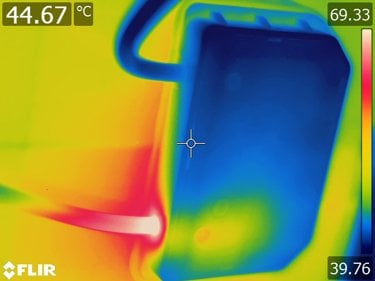
Following a year of site operation, Kiwa PI Berlin’s team in Spain were contracted to perform a routine inspection of a 12 MW Spanish site. During this inspection the Kiwa PI Berlin team discovered junction boxes with a noticeable temperature gradient via thermal imaging. Further investigations determined that 90% of the modules had junction boxes with this issue. The hottest part shown in these images was at the cable termination points inside the junction box.
The site owner spent more than 45,000€ over eight months to investigate the issue, inspecting every module on the site and conducting a root cause analysis. That analysis included Kiwa PI Berlin removing the junction box pottant on a sample of affected modules and discovering a crimping issue at the cable terminations. The bypass diode placement in the junction box prevented robust crimping of the cable, leading to weakened electrical connections. This issue can lead to higher electrical resistance and therefore lower performance, and in the worst case, to hot spots, arc faults and fires.
The module manufacturer was contacted but is not considering this a valid case for warranty replacement. The site owner will continue to evaluate the module performance and electrical insulation on an annual basis, and will attempt warranty claims in the future for any modules that experience catastrophic failures.
This type of issue can be missed in the TC200 thermal cycling test of IEC 61215 but has previously been identified during the extended TC600 thermal cycling testing in Kiwa PVEL’s PQP.
 |
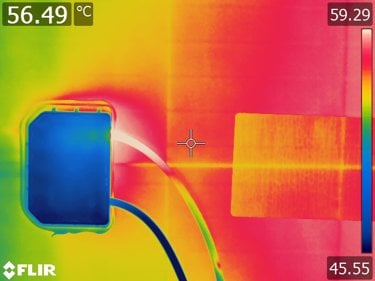 |
Thermal images showing hot spots at the junction box cable terminations.
Materials assessed
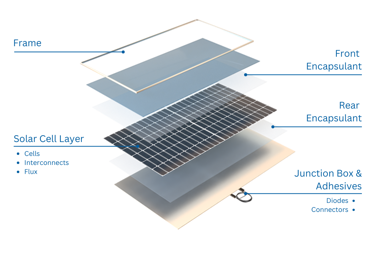
These materials are susceptible to failure due to thermal stress and/or are critical for solder bond reliability:
Test procedure
|
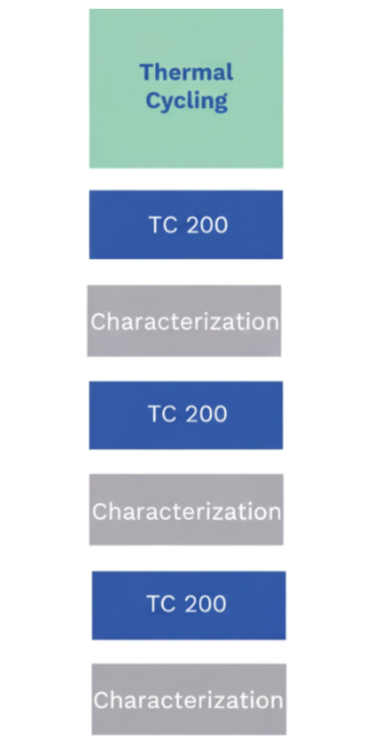
As materials in a PV module expand and contract with changing temperatures, material interfaces are mechanically stressed due to differences in coefficients of thermal expansion (CTE); resistive heating from current flow increases local stresses at solder joints and other electrical interfaces. Following the guidance of IEC 61215-2:2021 MQT 11 (including 5N weights applied to junction box during the PQP’s TC600 testing), the module is submitted to cycles of temperatures from −40°C to +85°C with current injection typically equal to Kiwa PVEL’s measured Imp post-light soaking (dependent on the module technology). The duration is 600 cycles, and characterization takes place every 200 cycles. The interim characterizations include IV, EL, WL and VI. The pre-stress and final characterizations also include LIC and LCEL, while the final characterizations also include diode test. For PQP testing of most bifacial modules the current injection is equal to front-side Imp at STC plus the equivalent of rear-side Imp at 300 W/m2 rear-side irradiance, as measured post-light soaking (“ImpBSI”). However, for bifacial modules with datasheets showing a bifacial gain of >30%, the corresponding current injection for TC testing will increase by 5-10% as per the calculation in IEC 61215-2 and IEC 67130-2 (“ImpaBSI”).
|
 |
PV Module Reliability Scorecard
Now available, Kiwa PVEL’s PV Module Reliability Scorecard features Top Performers from the industry’s best manufacturers and is the essential resource for PV module reliability and performance insights.
Visit the Kiwa PVEL PV Module Reliability Scorecard to see key takeaways, test result spotlights and Top Performers for this test.