

PAN and IAM
Why PAN and IAM testing matters
In their role as technical advisors, Kiwa PI Berlin, often works with project stakeholders to review the module manufacturer’s PAN files. PI Berlin’s analysis has revealed that, while conservative values are occasionally used, more frequently, manufacturer-provided PAN files contain aspirational assumptions for low light performance, temperature coefficients and/or IAM (Incidence Angle Modifier) curves.
Four recent examples of this specifically related to low light performance are detailed here, taken from different modules being considered for four different projects. In these cases, Kiwa PI Berlin was also shipped samples of the same modules to perform PAN measurements. The resultant measurement-based PAN files were compared to the manufacturer-supplied PAN files. To isolate the low light performance effects, all other PAN parameters were held constant between the two differently-sourced PAN files, which were then used in two PVsyst simulated sites. The site in Dublin, Ireland, has a higher frequency of low light conditions than the second site in Murcia, Spain, leading to more pronounced impacts of low light performance differences.
The results reveal that in all cases, the manufacturers’ low light performance assumptions were more aggressive than Kiwa PI Berlin’s measurements on the same modules, with deviations in specific energy yield ranging from 1.1% to 2.9%. While these differences might initially seem negligible, using these manufacturer-provided PAN files for utility-scale sites would lead to significant overvaluation in financial models, likely leading to underperforming assets that do not achieve their expected energy yield.
As part of Kiwa Solar’s Module Procurement Best Practices, third-party PAN testing is strongly recommended, both during module qualification, which is achieved via Kiwa PVEL’s PQP PAN testing, as well as during batch testing of modules being shipped to the project site, which is offered at all Kiwa Group labs.
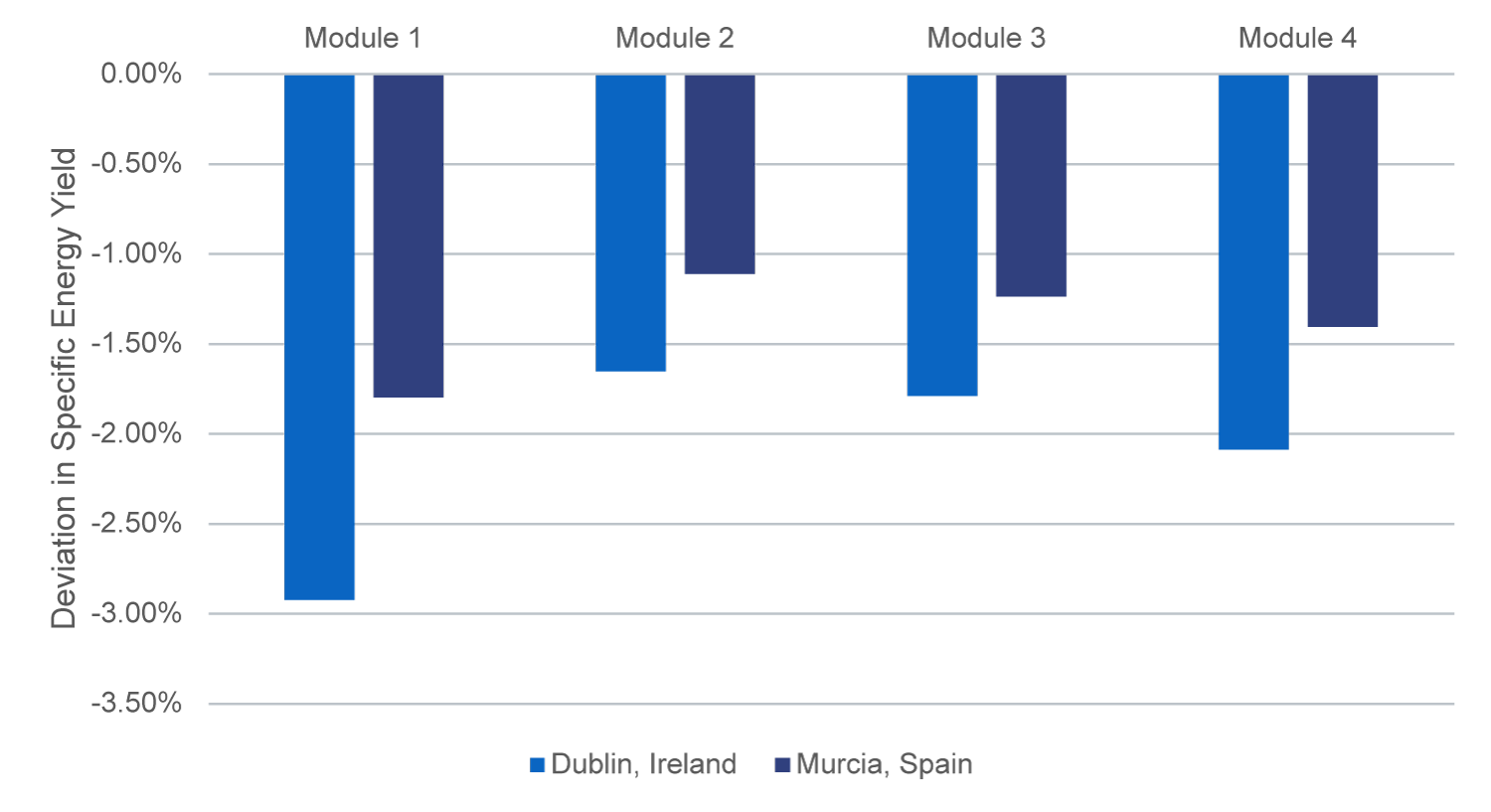
Differences in Specific Energy Yield (kWh/kWp) between Kiwa PI Berlin measured-PAN files and manufacturer-provided PAN files for four different modules at two simulated sites.
Materials Assessed
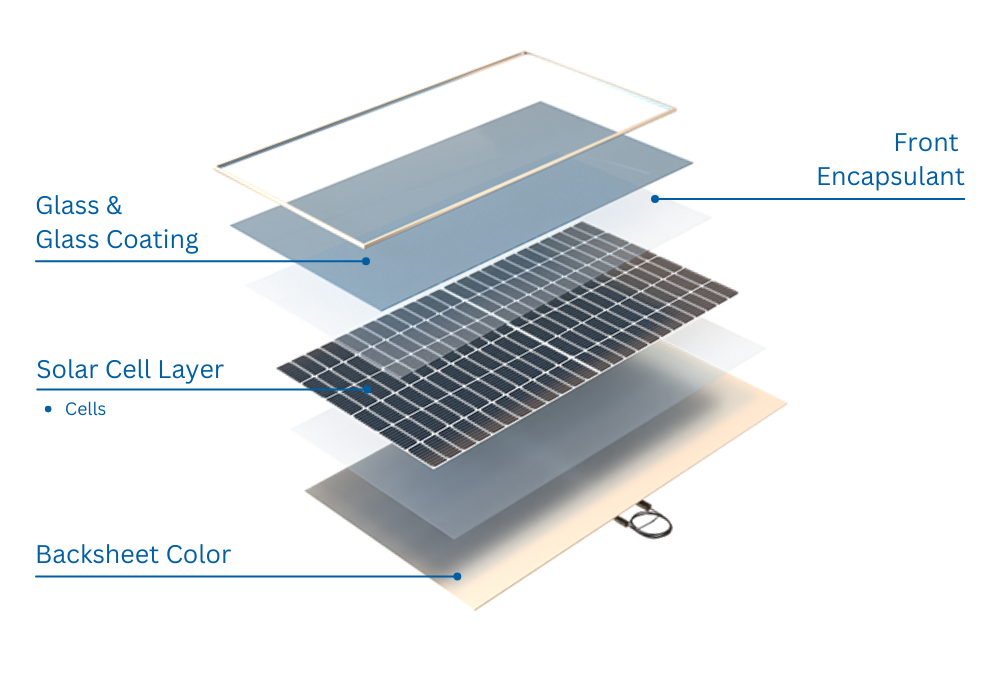
The cell has the greatest impact on PV module performance in the field, and certain cell technologies and designs (e.g., half–cut cell, heterojunction, thin film) can produce more or less energy in high temperature and/or low–light conditions. However, changes in the following components will impact PAN and/or IAM performance:
Test procedure
|
Kiwa PVEL calculates PVsyst module files (.pan files) based on independent module measurements. These are generated using the industry’s standard software – PVsyst. For PV energy yield simulations the PAN file represents the module’s measured performance. Kiwa PVEL follows IEC 61853-1 (table below) to measure 22 points with varying temperatures and irradiances. The testing is carried out on three modules for redundancy and improved accuracy. The measurement data is fit with the PVsyst single-diode model to obtain the most accurate agreement (curves below).
By default, Kiwa PVEL creates the PAN files suitable for Version 6.83 or greater of PVsyst. If Incident Angle Modifier (IAM) is performed on the same BOM, the PAN file may include the measured IAM data at the Customer’s request. No data quantifying light soaking effects will be included in the PAN file and accompanying report. Kiwa PVEL’s PAN reports include the result of using the measured PAN file at six different international reference climates, coupled with four common mounting configurations as per IEC 61853-3 and IEC 61853-4. The 24 resultant energy yields help contextualize the PAN testing results. For bifacial modules, a complete characterization of the three PAN modules is conducted following the guidance of IEC TS 60904-1-2:2019. The PAN report includes a bifacial section that reports the following bifacial data:
The PAN file report also includes a stated "Bifaciality Factor", i.e. the ratio of the nominal efficiency at the rear side with respect to the nominal efficiency of the front side. The PAN file generated uses this measured “Bifaciality Factor”. Note: the nominal efficiency is simply the nominal Power (under STC) expressed in kWp, divided by the area of the PV module (in m²). This “Bifaciality Factor” will be used in PVsyst or in other similar modeling software where bifacial data is considered when modelling the bifacial module’s energy generation. The PAN file generated based on the measurements described above can be extrapolated to power classes within +/- 3% of nameplate Pmax. No additional modules are required for extrapolated PAN files and reports, but these extrapolations can only extend to power classes shown on the submitted datasheet. Additional charges apply for extrapolations. Note that PAN testing is optional within the larger scope of a PQP, but it is strongly recommended as many downstream entities require Kiwa PVEL PAN files and IAM reports. Incidence Angle Modifier (IAM) coefficients evaluate the response of a PV module to light coming from a non-normal angle. IEC 61853-2:2016 defines an indoor test method for characterization of the IAM values of a PV device with respect to the angle of incidence (AOI) by measuring short-circuit current (Isc). Kiwa PVEL has improved upon this test method for characterization of the IAM profile for PV modules, including both glass//backsheet and glass//glass modules. Kiwa PVEL’s indoor IAM testing method has shown superior results for precision and repeatability. The testing is carried out on three modules for redundancy and improved accuracy. For PQP testing of bifacial modules, only the front-side will receive IAM measurements. Note that IAM testing is optional within the larger scope of a PQP, but it is strongly recommended as many of downstream entities require Kiwa PVEL PAN files and IAM reports. |
 |
||||||||||||||||||||||||||||||||||||||||||||
PV Module Reliability Scorecard
Now available, Kiwa PVEL’s PV Module Reliability Scorecard features Top Performers from the industry’s best manufacturers and is the essential resource for PV module reliability and performance insights.
Visit the Kiwa PVEL PV Module Reliability Scorecard to see key takeaways, test result spotlights and Top Performers for this test.