UTILITIES EXPOSED: Daylighting’s Transformative Power in Revolutionizing Risk Mitigation and Cost Optimization
QL-A daylighting in SUE delivers precise utility location, reduces excavation risk, prevents delays, and supports safer, cost-effective infrastructure projects.
In the intricate world of Subsurface Utility Engineering (SUE), Quality Level A (QL-A) stands as the pinnacle of precision and accuracy – in the industry this is commonly known as ‘daylighting’.
This level of investigation involves non-destructive methods that pinpoint the exact horizontal and vertical location of underground utilities. In this blog post, we explore the significance of Quality Level A in SUE practices, its methodologies, and the transformative impact that daylighting can have on infrastructure projects.
Tiered Classification of SUE
SUE employs a tiered classification system to categorize the level of information available about underground utilities according to standards set by ASCE 38-22 (American Society of Civil Engineers).
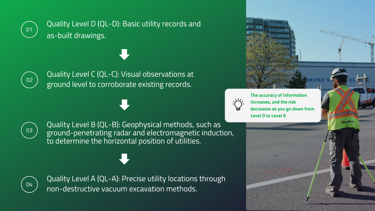
This tiered approach allows project managers, with consultation from SUE experts, to choose the level of SUE investigation that aligns with the project’s complexity and risk tolerance. The primary goal of SUE is to minimize the risks associated with excavation and construction, preventing accidental utility damage and service disruptions.
Investing in SUE upfront may seem like an additional cost, but it often results in significant savings in the long run. Accurate utility mapping helps streamline project timelines, minimize change orders, and avoid costly delays and repairs. Efficient project management, facilitated by SUE practices, contributes to overall cost-effectiveness.
QL-A Daylighting: The Process
Conducting a SUE QL-A survey involves a meticulous and systematic approach to unveil the precise horizontal and vertical locations of underground utilities. The process begins with a comprehensive review of existing utility records, as-built drawings, topographic plans and any available historical information This produces the QL-D and QL-C drawings. Following this initial data collection, geophysical methods such as ground-penetrating radar and electromagnetic induction are strategically employed to determine the horizontal positions of utilities- bring the data up to QL-B.
However, the pinnacle of precision is achieved through non-destructive vacuum excavation methods. This involves carefully exposing and visually confirming the utility’s location without causing damage. At this QL-A stage, utility information is gathered and recorded to be added to reports and CAD drawings afterwards. SUE CAD drawings are then updated to display the range of utility data collected across all of the quality levels.
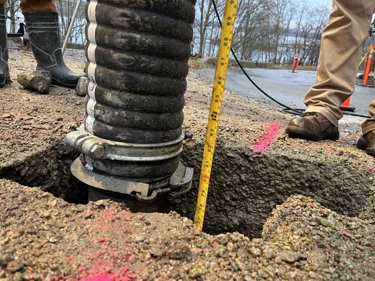
Behind the scenes of the field work is the project management and coordination between various stakeholders, including project owners, property owners, relevant utility providers, daylighting and paving companies, and traffic control personnel. Municipal permitting is also required to comply with local regulations.
The entire process is orchestrated by experienced professionals ensuring a seamless and accurate QL-A investigation that aligns with the project’s complexity and risk tolerance. Investing in SUE QL-A data is an investment in project safety, efficiency, and long-term financial savings, making it an indispensable asset in the successful management and execution of infrastructure projects.
QL-A Daylighting: The Benefits
In the evolving landscape of subsurface utility engineering, Quality Level A emerges as the gold standard for precision and accuracy. As technology continues to advance and non-destructive excavation methods become more sophisticated, QL-A practices will play an increasingly vital role in shaping the success of infrastructure projects large and small. Embracing the power of SUE isn’t just a choice; it’s a commitment to a future where subsurface utility engineering is synonymous with precision, safety, and unrivaled accuracy.
Why is Daylighting Required on Your Project
The primary objective of SUE is to effectively mitigate excavation and construction risks, thereby averting utility damage, project delays, and service disruptions. Evaluating project risk and determining the necessary level of information represents a crucial step in ensuring successful project completion. While some projects may suffice with record level or basic field level data, such as is obtained through a SUE QLD or QLC investigation, larger and more complex endeavors demand a higher degree of accuracy to safeguard both the safety and cost efficiency of the project.
When precision in utility positional data is paramount, a SUE QLB investigation in conjunction with a QLA daylighting investigation emerges as an indispensable tool, playing a fundamental role in eliminating risks associated with uncertainty.
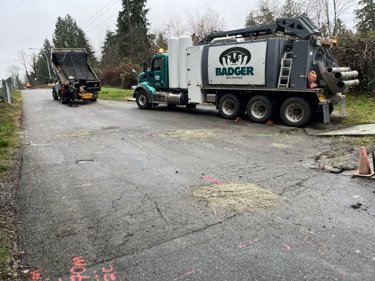
Before proceeding with any construction project, large or small, consult with a SUE expert to assess your project’s complexity, and make the strategic decision to invest in precision that pays off.
If the project demands the highest degree of accuracy, join the ranks of successful projects that have harnessed the benefits of daylighting, ensuring a seamless, risk-free, and cost-effective construction project.