
Underground Storage Tank (UST) Investigations
Receive a quote tailored to your needs
What is it and what it includes
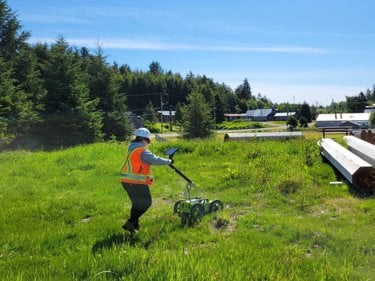
Underground Storage Tank (UST) Investigations help determine whether buried tanks may be present beneath a property. Kiwa T2 uses Ground Penetrating Radar (GPR), a non-destructive geophysical method that uses electromagnetic energy to detect subsurface anomalies associated with metallic and non-metallic underground features, including storage tanks. The technology can identify changes in subsurface conditions without excavation.
Investigations can be tailored to a specific area of concern or expanded into a comprehensive site-wide survey. During the assessment, Kiwa T2 collects and interprets GPR data to identify anomalies that may indicate the presence of current or former underground storage tanks. Where no tank-like anomalies are detected within the areas investigated, the survey can provide additional confidence regarding site conditions.
For whom are Underground Storage Tank Investigations relevant?
This service by Kiwa T2 is intended for property owners, developers, environmental consultants, real estate professionals, industrial facility operators, institutions, and organizations performing environmental due diligence or property redevelopment projects. These clients are typically involved in property transactions, site redevelopment, environmental assessments, infrastructure upgrades, risk management, and investigations of historical site conditions.
Benefits of the Service
- Non-destructive investigation without excavation or ground disturbance
- Helps identify potential underground storage tank locations before construction or redevelopment
- Supports environmental due diligence and property risk assessments
- Reduces uncertainty associated with historical property use
- Provides actionable information to support decision-making
- Allows targeted follow-up investigations rather than broad intrusive testing
- Minimizes disruption to site operations during fieldwork
Why choose Kiwa T2?
Kiwa T2 specializes in subsurface investigations and risk mitigation, combining advanced geophysical technologies with experienced interpretation and analysis. The company delivers reliable subsurface information that helps clients make informed decisions and reduce uncertainty. Kiwa T2's geophysical services are designed to reveal subsurface conditions while minimizing disruption to the site and surrounding environment.
Our team utilizes Ground Penetrating Radar technology capable of detecting both natural and man-made underground features, including storage tanks, while providing professional interpretation of survey results.
Steps in the Process
Initial Consultation
Discuss project objectives, areas of concern, property history, and available site information.
Investigation Planning
Define survey limits, site access requirements, and the appropriate GPR methodology.
Field Investigation
Conduct Ground Penetrating Radar scanning across targeted areas or the full site.
Data Review and Interpretation
Analyze collected data to identify anomalies that may indicate underground storage tanks or other subsurface features.
Reporting and Mapping
Prepare investigation drawings, findings, and supporting documentation.
Recommendations
Provide guidance regarding potential follow-up investigations where anomalies warrant additional evaluation.
Contact our experts
Whether you're evaluating a property, planning redevelopment, or investigating historical site conditions, Kiwa T2 can help identify potential underground storage tank locations with confidence. Contact our team to discuss your project and determine the right investigation approach for your site.
FAQs about Underground Storage Tank Investigations
What is a UST investigation?
A UST investigation is a subsurface assessment performed to identify anomalies that may indicate the presence of underground storage tanks or related buried infrastructure.
How does Ground Penetrating Radar locate underground storage tanks?
GPR transmits electromagnetic signals into the ground and records reflections from subsurface features. Tank-sized anomalies and changes in subsurface conditions can often be identified through interpretation of the collected data.
Does a GPR survey require excavation?
No. GPR is a non-invasive technology that allows investigations to be completed without disturbing the ground surface.
Can Kiwa T2 investigate only a portion of a property?
Yes. Investigations can be focused on specific areas of concern or expanded to cover an entire site, depending on project requirements.
Does a GPR survey confirm that no underground tank exists?
GPR can identify detectable anomalies within the surveyed area. However, all geophysical methods have limitations, and the absence of a detectable anomaly does not guarantee that no underground storage tank exists under all site conditions.
What happens if a potential tank anomaly is identified?
If a potential UST anomaly is detected, Kiwa T2 may recommend additional investigative methods or intrusive verification techniques to confirm the nature of the feature.
Urban Geophysics
Identify hidden subsurface features and anomalies with advanced geophysical investigations that help reduce uncertainty, manage risk, and support informed project decisions.
Site Characterization Support
Kiwa T2 provides advanced geophysical investigations that help clients understand subsurface conditions, identify anomalies, and make informed environmental, remediation, and engineering decisions.
Private Locates
Identify and mark privately owned underground utilities before excavation, construction, or site development activities begin.
Visual Verification of Utilities (Hydro-Vac Excavation)
Direct observation and documentation of exposed utilities to confirm their location and attributes supporting accurate records, design decisions, and construction activities.