
Volume calibration of storage tanks using 3D scanning - an accredited and highly accurate method

Volume calibration of storage tanks is a vital part of safe process‑industry operations and ensures the reliability of trading liquid products sold by volume. Accurate volume data is essential for the storage, handling and sale of chemicals, fuels and other industrial liquids, as well as for process control and fulfilling regulatory requirements.
Traditionally, calibration has required time‑consuming manual measurements performed with measuring tapes, often resulting in extended shutdowns. While functional, the method is laborious, slow and prone to small measurement errors. This has now changed with the introduction of a precise and highly efficient 3D laser‑scanning method.
A new era in tank volume measurement
The new 3D laser‑scanning technique represents a significant technological advancement. It is based on collecting millions of measurement points from the tank’s internal surface. These points form a highly accurate surface‑mesh model that captures the tank’s geometry with millimetre‑level precision and creates a complete digital representation. Based on this model, the true volume of the tank can be calculated with high accuracy using its full geometry.
In addition, 3D scanning enables verification of the scale and calibration accuracy of level gauges.
The raw data is processed in dedicated software and then reviewed at a calibration laboratory located in Estonia, where factors such as, temperature correction, steel wall-thicknesses, density of content and other structural characteristics are taken into account. The customer receives an official accredited report along with a complete dataset describing the tank’s volume in prescribed levels.
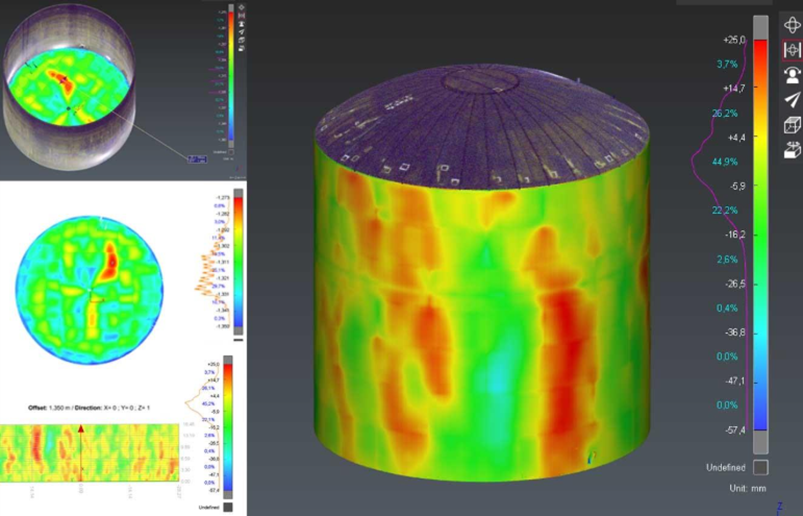
In the image, the local shape of the tank bottom and wall is shown as a color map.
Why choose 3D scanning for volume calibration?
The advantages of 3D laser scanning are significant:
Speed
Accuracy
Digital twin
Reduced downtime
Safety
Lower staffing requirements
This method is particularly suitable for large flat‑bottom storage tanks. The measurement can be performed as part of a regular out‑of‑service inspection or combined with other inspection activities, allowing all essential data to be collected in a single visit.
Kiwa Finland and Kiwa Estonia are among the few accredited service providers
Kiwa Finland, together with Kiwa Estonia, provides modern, accredited 3D laser‑scanning‑based volume calibration in accordance with ISO 7507‑4 standard. Accreditation ensures that calibration certificates are issued using an internationally recognised, standards‑compliant method. Customers can rely on results that are consistent, traceable and accepted by regulatory authorities.
3D scanning brings a new level of efficiency and reliability to storage‑tank inspections. Accredited methodology ensures consistent quality and dependable results.
Kiwa helps ensure that tank volume data is accurate and trustworthy—always safely, professionally and using modern, state‑of‑the‑art methods.

Contact us!
Do you need more information about Kiwa 3D laser‑scanning‑based volume calibration? Fill the form to contact our experts.