

Battery Passport – EU Regulation-Compliant Digital Solution
Receive a quote tailored to your needs
What is it and what it includes
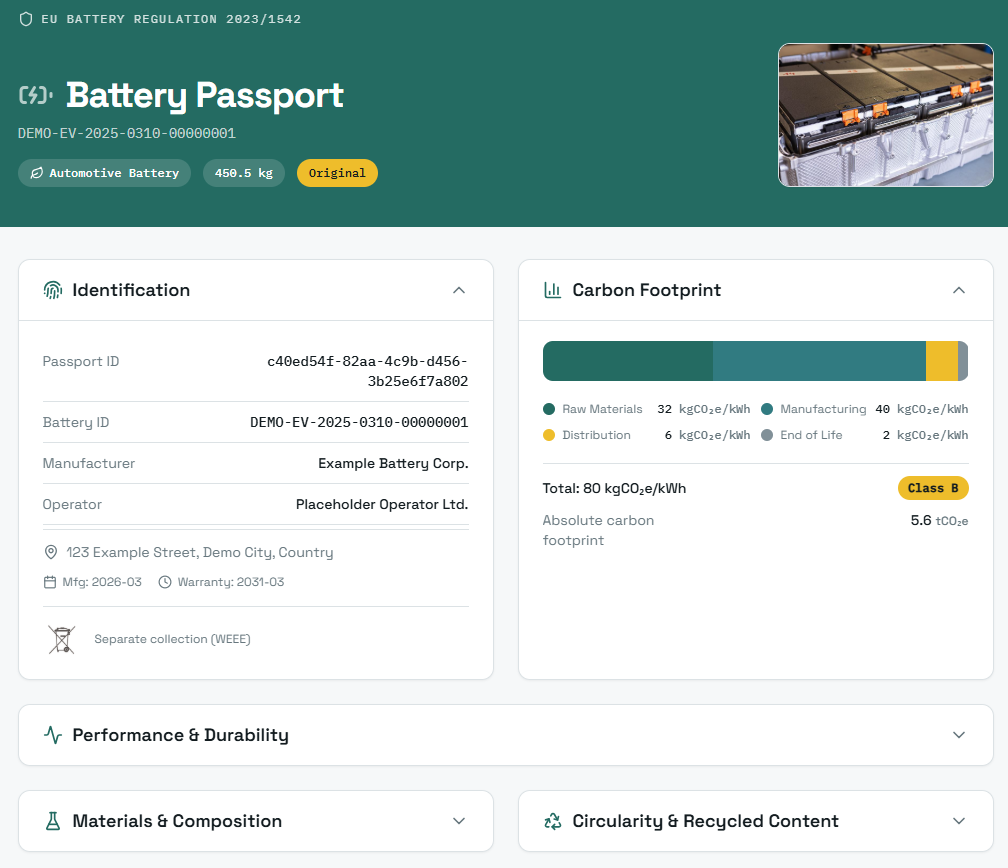
The Battery Passport is a digital record required by the EU Battery Regulation (EU) 2023/1542, providing structured, harmonized data on battery identification, safety, carbon footprint, materials, supply chain due diligence, and circularity. It acts as a Digital Product Passport (DPP) specifically for batteries, designed to increase transparency and sustainability across the entire battery value chain
Kiwa’s solution supports all mandatory data fields, offers APIs for static and dynamic data uploads, and ensures tamper-proof identity management. All information on the battery can be accessed via a platform. The platform enables secure, role-based access and comprehensive dashboards for monitoring and reporting, fully aligned with regulatory requirements.
Who is it for?
This service is designed for manufacturers, importers, and operators of electric vehicle (EV) batteries, industrial batteries above 2 kWh, and light means of transport (LMT) batteries such as e-bikes and e-scooters. It is also relevant for supply chain managers, compliance officers, and organizations placing batteries on the EU market or in service.
Benefits of the Service
- Ensures full compliance with EU Battery Regulation and DIN DKE SPEC 99100.
- Facilitates transparent data sharing across the battery value chain.
- Enhances traceability, safety, and sustainability of batteries.
- Supports efficient data management with automated uploads and secure APIs.
- Provides robust data protection and access control for sensitive information.
- Enables organizations to prepare for the 2027 regulatory deadline with confidence.
- Improves market access and reputation by demonstrating regulatory adherence.

Why choose Kiwa?
Kiwa is recognized for its expertise in testing, inspection, and certification, with a strong track record in digital compliance solutions. The Battery Passport platform is developed in line with the latest EU and DIN standards, ensuring clients benefit from up-to-date regulatory knowledge and technical excellence.
Kiwa’s independent position, global presence, and commitment to data security make it a trusted partner for organizations navigating complex compliance landscapes. Clients receive ongoing support, expert guidance, and access to a scalable, future-proof digital solution.

Steps in the process
Initial Consultation
Platform Onboarding
Data Upload
Verification and Validation
Ongoing Monitoring
Regulatory Reporting
Applicable norms and regulations
- EU Battery Regulation (EU) 2023/1542
- DIN DKE SPEC 99100:2025
- Battery Regulation Annex XIII
- Article 77(2) of the EU Battery Regulation
Frequently Asked Questions
What is the Battery Passport?
The Battery Passport is a digital, electronic record required under Article 77 of the EU Battery Regulation (EU) 2023/1542.
It acts as a Digital Product Passport (DPP) specifically for batteries, designed to increase transparency and sustainability across the entire battery value chain — manufacturing, use phase, and end of life.
A Battery Passport contains structured and harmonized data on topics such as:
• identification and traceability
• safety and performance
• carbon footprint
• materials and composition
• supply chain due diligence
• circularity and end of life information
Which batteries require a Battery Passport?
The requirement applies to electric vehicle (EV) batteries, industrial batteries above 2 kWh, and light means of transport (LMT) batteries such as e-bikes and e-scooters placed on the EU market or put into service from February 2027.
What information is included in the Battery Passport?
The passport covers unique identifiers, manufacturer details, safety symbols, carbon footprint, supply chain due diligence, materials, circularity, and performance data, as specified in Annex XIII of the regulation.
How is data security managed?
Protecting sensitive battery data is essential for complying with the EU Battery Regulation and for ensuring trust across the battery value chain. Kiwa’s Battery Passport technology provides a robust security framework that combines controlled access, data segregation, and secure digital identities to keep all Battery Passport information safe.
When does the Battery Passport become mandatory?
From 18 February 2027, all relevant batteries placed on the EU market or put into service must have a compliant Battery Passport.
Battery testing according to UN 38.3
Batteries containing lithium must be tested in accordance with UN 38.3 to ensure safe transport.

Carbon Footprint of Products (CFP)
A Product Carbon Footprint (PCF) following ISO 14067 records the total CO2 emissions that occur directly or indirectly over the life cycle of a product.