
Prepare for the EU battery passport

From 18 February 2027, EV batteries, LMT batteries (such as e-bikes and e-scooters) and industrial batteries above 2 kWh can only be placed on the EU market with a digital battery passport. A battery passport is more than a label or a datasheet. It is a digital record, reached through a QR code, that shows what a battery is made of, where it comes from and how it performs over its life.
Two sets of rules, one passport
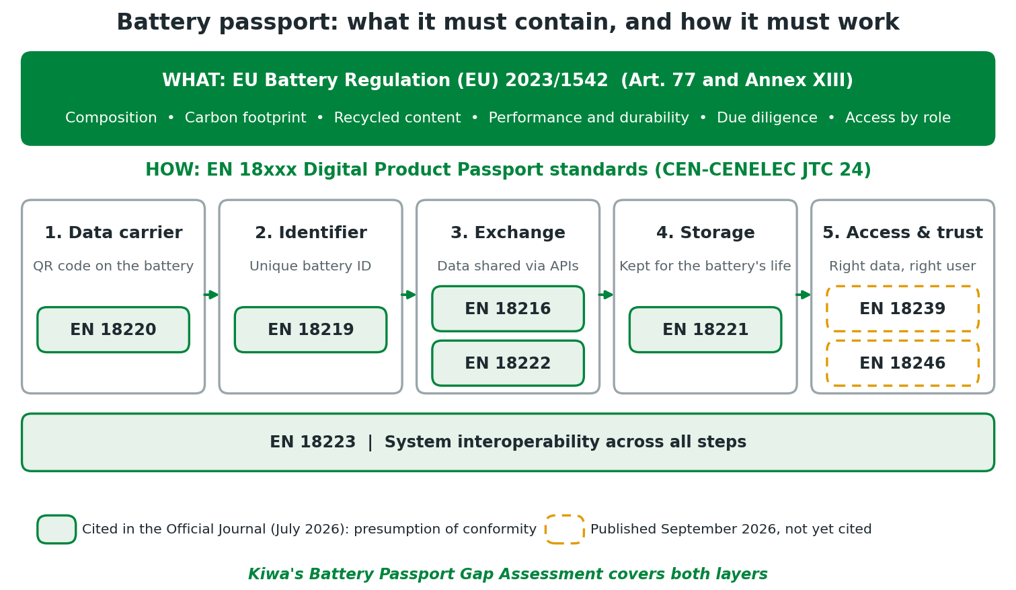
The EU Battery Regulation (EU) 2023/1542 sets what the passport must contain. Article 77 and Annex XIII list the required information, including:
- material composition
- carbon footprint
- recycled content
- performance and durability
- supply chain due diligence
The EN 18xxx standards set how the passport must work. These eight standards were developed by CEN-CENELEC JTC 24. They apply to digital product passports in every sector, so they describe how a passport works, not what data it must hold.
- Cited in the Official Journal of the EU (July 2026). Six standards. A passport that meets them is presumed to conform to the corresponding requirements:
- EN 18220: Data carriers
- EN 18219: Unique identifiers
- EN 18216: Data exchange protocols
- EN 18222: APIs and searchability
- EN 18221: Storage and persistence
- EN 18223: System interoperability
- Published in September 2026, not yet cited. Two standards:
- EN 18239: Access rights, security and confidentiality
- EN 18246: Data authentication and integrity
For the first time, there is a complete, published technical benchmark to test your battery passport against.
Two ways a battery passport can fall short
Getting only one side right is not compliance.
Strong technology, weak data
Complete data, unreadable passport
What our Battery Passport Gap Assessment covers
Regulatory readiness: EU Battery Regulation
• Which of your batteries are in scope, and what your role is as an economic operator • Whether your data is available and good enough for each Annex XIII requirement • How strong your evidence is: carbon footprint, recycled content, performance and durability, and supply chain due diligence • Access rights: what the public, authorities and notified bodies, and parties with a legitimate interest (such as repairers and recyclers) can each see
Technical readiness: EN 18xxx standards
• Identifiers and data carriers (EN 18219, EN 18220) • Data exchange, APIs and the link to the EU registry (EN 18216, EN 18222) • Storage, persistence and interoperability (EN 18221, EN 18223) • Access rights, security and data authenticity (EN 18239, EN 18246)
Prioritized roadmap
Clear actions, owners and timing to close every gap before the deadline.
Know your gaps before the deadline
Getting your battery passport ready starts with knowing where you stand. Kiwa's independent gap assessment shows you your regulatory and technical position, so you can act with confidence before February 2027.

Contact us
To discuss your battery passport readiness, contact our experts.